
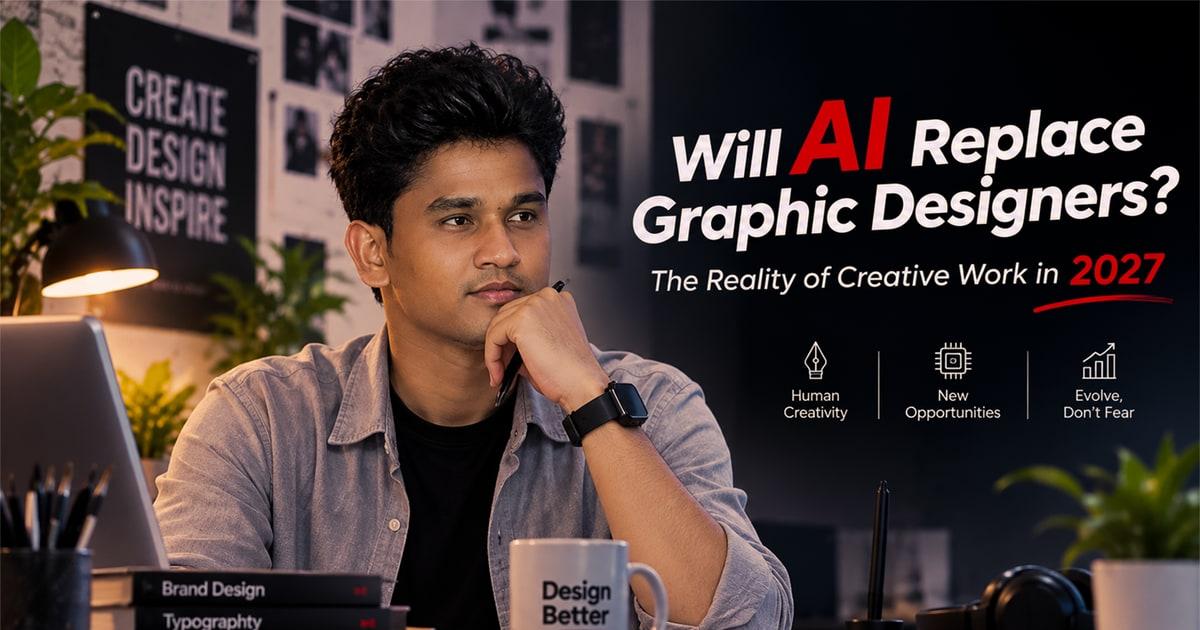
Every few weeks, a client sends over a screenshot they generated on their phone at midnight. Usually, it is a glossy, slightly surreal logo mockup or a social media banner with six-fingered hands and letters that melt into each other if you look too closely. Attached to the image is the question every working designer has heard a dozen times over the past year: "Since the concept is basically done, we just need you to clean this up quickly, right?"
That single message captures the reality of graphic design heading into 2027 better than any keynote speech.
For a long time, the industry comforted itself with the idea that artificial intelligence was just a toy for making weird mood boards. Nobody working in a studio believes that anymore. According to the AI in Design Report 2026, 91% of designers now use AI tools at least once a week, up from 54% in 2025, and 75% use them every single day. We use them to extend backgrounds, test lighting, strip out objects, and pitch rough concepts before committing hours to a layout.
At the same time, it is hard to ignore the knot in the stomach that many creatives feel when looking at job boards. When the World Economic Forum's Future of Jobs Report 2025 surveyed 1,000 global employers representing 14 million workers, traditional graphic design landed as the 11th fastest-declining job category through 2030. Yet in that exact same report, UI and UX design ranked as the 8th fastest-growing field.
So are graphic designers actually being replaced in 2027? If your entire job consists of moving rectangles around a template or cutting out product photos, yes. That market is drying up fast. What is actually disappearing, though, is not design itself. It is the era where you could make a comfortable living purely on software mechanics without strategic thinking, technical depth, or a distinct point of view.
The Quiet Disappearance of "Production-Only" Work
If you look back at how design studios made money five years ago, a huge chunk of billable hours came from routine production. A senior designer or art director would set the visual direction for a campaign, and then junior or mid-level designers would spend days resizing banners into twenty formats, typesetting multi-page brochures, or mocking up packaging variations.
Today, software handles most of that heavy lifting in minutes. An analysis of U.S. Bureau of Labor Statistics data by OneHour Digital points out that AI already performs or assists with roughly 65% of routine graphic design production tasks. You can see the divide clearly when you compare ten-year employment projections across different creative roles in the 2025–2035 U.S. Bureau of Labor Statistics outlook and the AI Resilience Report for Graphic Designers 2026:
| Creative Role | 10-Year Job Outlook (2025–2035) | What Software Is Taking Over | What Clients Still Pay Humans For | Source |
|---|---|---|---|---|
| Desktop Publishers | -14.5% | Routine page formatting, catalog population, and standard text flow | Complex prepress checks, custom print specs, and physical production control | OneHour Digital / BLS |
| Graphic Designers | -1.7% (~16,000 openings/year remain) | Quick social graphics, stock imagery, and basic single-page layouts | Brand identity systems, typographic craft, and cross-media storytelling | OneHour Digital / BLS |
| Art Directors | +4.2% | Early mood boards and fast visual variations | Taste, campaign positioning, client trust, and knowing what to cut | OneHour Digital / BLS |
| Web & Digital Interface (UI/UX) Designers | +6.0% | Basic wireframes and boilerplate component code | Complete user journeys, scalable design systems, and live frontend architecture | Extern / BLS |
Freelance marketplaces felt the tremor first. Research from Imperial College Business School cited in the Extern 2026 Design Outlook found that graphic design and 3D rendering postings on a major freelance platform dropped 13% shortly after text-to-image tools arrived, with simple, low-budget gigs vanishing right away.
Yet companies are not firing their creative partners en masse. When AIGA and Fast Company surveyed 1,273 freelance designers and 153 hiring companies in July 2026, as covered in the Extern 2026 Design Outlook, nearly two-thirds of freelancers admitted they were worried about AI hurting their business, while only 14% of hiring managers expected to hire fewer freelance designers over the next year. Clients still need designers. They just refuse to pay agency rates for work a $20 subscription can spit out before breakfast.
What Actually Frustrates Designers on the Ground Today
Talk to working designers right now and you will rarely hear them complain that AI is "too good." In practice, the daily headache is almost the opposite: AI makes it effortlessly easy to generate something mediocre, and painfully slow to get something exact.
The "Close Enough" Trap
Generative tools are great when you do not care about the details. The moment a real client asks you to keep the exact composition of an illustration, shift the camera angle five degrees, and match their brand's specific Pantone shade, prompt-based tools fall apart. In Adobe's November 2026 Creators Survey, 68% of creators admitted they regularly settle for an AI output that does not quite match what they had in mind. Worse, 47% gave up on an AI tool mid-project in the prior three months because coaxing the right result took too much effort, with 27% of those frustrated that changing one small detail meant ruining the rest of the image.
The Illusion of the Five-Minute Project
Because commercial AI subscriptions cost $10 to $30 a month, as noted in the AI Resilience Report for Graphic Designers 2026, non-designers often assume that an entire rebrand or corporate proposal now takes an afternoon. They see the five seconds it takes to generate a picture, not the twenty hours required to build a coherent grid, fix awkward kerning, structure hierarchy across languages, and make the identity work on everything from a mobile header to an embroidered uniform.
Everything Starting to Look the Same
Scroll through LinkedIn, Instagram, or Behance today and you can spot the default look of generative models from across the room: hyper-smooth lighting, plastic skin textures, and suspiciously symmetrical compositions. In Graphic Design USA's coverage of Adobe's 2026 Creator Study, 53% of creators who say it is harder to stand out today blame the sheer flood of content, while 42% point directly to AI-generated visuals making every brand look interchangeable.
The Wall Between a Pretty Picture and Real Production
Anyone who has ever sent a job to a commercial print shop or pushed a live website into production knows that a JPEG is not a deliverable. An image generator cannot build clean vector paths for a vinyl plotter, set proper CMYK ink limits so dark paper does not smudge on press, calculate packaging bleed and fold lines, or write clean, accessible CSS and React components. The gap between a cool screen mockup and a file that actually works in the physical or digital world is still bridged entirely by human craft.
The Bigger Challenges Waiting in 2027
As we move deeper into 2027, the pressure on designers is shifting away from "can a machine draw better than me?" toward three tougher structural problems.
First, the junior career ladder is breaking. Most senior designers learned their craft by spending their first two years doing repetitive production tasks while sitting next to an experienced art director. Now that software automates that grunt work, agencies are hiring fewer beginners. Figma's February 2026 hiring data, reported in the Extern 2026 Design Outlook, showed that 56% of design leaders saw rising demand for senior designers, compared to just 25% for junior roles. Young designers entering the market in 2027 are expected to think like art directors and systems designers almost from day one.
Second, workflows are moving from single prompts to autonomous agents. We are moving past typing a sentence into an image generator. Newer agentic tools can read a brand guideline, resize and localize fifty campaign assets, and organize layout variations on their own. According to Adobe's November 2026 Creators Survey, creators already using AI agents report a 59% net time savings even after checking and refining the output, and 36% say agents allow them to take on complex projects that used to require a much larger team. For solo designers and small studios, learning how to direct and quality-check these workflows is becoming a major competitive edge.
Third, clients want proof of originality and legal safety. A serious business cannot build its trademarked identity on scraped artwork that anyone else can replicate or challenge in court. In Graphic Design USA's report on the 2026 Adobe Survey, 90% of creators emphasized how critical copyright protection is for AI-assisted work, 75% said audiences can already tell when AI was heavily used, and 85% noted that audience expectations around transparency keep climbing. In 2027, clients are paying a premium for documented human authorship and clean commercial rights.
Why Good Designers Still Have the Upper Hand
For all the noise about automation, machines still fail at the exact things that make design valuable to a business in the first place.
A client almost never comes to you asking for the right thing. They ask for a "modernized logo" or a "fresh flyer" when their real problem is that their pricing looks cheap, their messaging confuses customers, or their website is impossible to navigate on a phone. Diagnosing that problem takes conversation, business intuition, and empathy. That is why global employers in the World Economic Forum's Future of Jobs Report 2025 rated AI's ability to replicate genuine creative thinking as "low" or "very low," ranking creative thinking 4th among all workplace skills growing in importance through 2030.
Machines also have no sense of restraint. Left to itself, generative software always wants to add more: more gradients, more detail, more visual noise. Good design is mostly about what you take away. Knowing when a layout needs breathing room, why a specific Arabic or Latin typeface carries the right cultural weight, or how a physical paper stock feels in a customer's hand comes down to human taste—something 81% of creators in Graphic Design USA's 2026 survey coverage agree no algorithm can replace.
How to Position Yourself for 2027
If you run a small studio or work as an independent designer, 2027 is actually a great time to compete against bloated legacy agencies. In fact, Graphic Design USA's 2026 report found that 58% of independent creators and small teams feel stronger competing against big agencies since bringing AI into their workflow. You can move faster than a twenty-person firm while keeping your personal standards intact.
To stay ahead of the curve in 2027:
- Sell systems and outcomes, not isolated files: Stop charging by the hour or by the single flyer. Package your work around complete brand systems, cohesive campaign identities, and digital interfaces where your strategic thinking drives the value.
- Own the technical last mile: Whether that means mastering complex print production and custom scripts in Illustrator or building live, responsive web interfaces in modern frontend frameworks, become the person who can turn a visual idea into a working reality without handoff headaches.
- Show the thinking behind the polish: As highlighted in the Extern 2026 Design Outlook, clients and hiring directors no longer trust a portfolio that only shows pretty final mockups. Show the messy sketches, explain the business problem you solved, and point out the deliberate human decisions that made the piece work.
- Lean into unmistakable human craft: When the internet is drowning in synthetic, generic imagery, custom typography, clean editorial grids, honest photography, and tactile print details stand out immediately.
AI is not ending graphic design in 2027. It is just clearing out the middle ground. The designers who treat software as their entire identity will struggle, while the designers who bring real taste, technical mastery, and honest problem-solving to the table will be harder to replace than ever.

Qudama Rafiq
Creative Director & Graphic Designer with 10+ years of experience helping brands build lasting visual identities.
Hire MeRelated Articles
View All
Building My Creative Portfolio as a Real World System
Discover how I built my official portfolio using Next.js 16, Tailwind CSS 4, and a clean single-language architecture. A deep dive into design systems, performance, and engineering.
Read More
Modern Web Development in 2025: What Every Designer Should Know
A designer's guide to the latest in modern web development. Learn how frameworks, responsive layouts, headless CMS, and performance tools are reshaping the way we design for the web in 2026.
Read More
The New Wave of Graphic Design: Trends Shaping 2025
Graphic design continues to evolve, sometimes in small increments and sometimes through significant creative shifts. As we enter 2025, a fresh wave of ideas, techniques and visual styles is shaping the industry. For designers, it is an inspiring moment because the walls between print, digital, branding and storytelling feel more open than ever. This new era encourages experimentation, personality and smarter workflows that support creativity rather than limit it.
Read MoreReady to Start Your Project?
Let's discuss how we can bring your vision to life with thoughtful design and expert execution.
Get in Touch